
Mike Wade, VP of Customer Success
When you consider the skills a senior analyst has that junior-level personnel have yet to acquire, you probably think about query-language fluency, deep familiarity with log sources, an understanding of the environment, and the ability to build and tune detections. Now sort those bullets into two piles: the ones that describe judgment and the ones that describe expert knowledge of the environment.
The judgment pile is important, but it’s thinner than you might initially expect. Much of what the senior analyst brings to the table is knowing where the data lives, what the field names are this quarter, what normal looks like on a Tuesday, and how to turn a hunch into a working query before the incident gets cold. That knowledge comes with experience, but today, much of it can be made accessible through AI without requiring every analyst to spend years acquiring it. With Gravwell 5.10, this environmental knowledge becomes accessible across the team, regardless of individual experience level.
Having this knowledge at hand broadens an analyst’s reach, meaning their ability to access, understand, and act on security data and institutional knowledge beyond what their individual experience or technical expertise would ordinarily allow.
The Senior-Level Knowledge Chokepoint
At a typical organization, when you break down what a senior analyst must do because a junior can’t, it can boil down to four things:
They know where the data is. Which tag holds the Okta events, which one went quiet in March and never came back, which vendor moved a field two levels deeper in the JSON without telling anyone. The junior analyst knows the data exists, but the senior knows the address.
They know what normal looks like. Four hundred failed logins an hour might be a normal day for the payroll service account but a five-alarm fire for a domain admin. That distinction is not written down anywhere. It lives in the mind of whoever has been staring at the environment the longest.
They speak the query language natively. For the senior analyst, the hunch and the query are the same thought. The junior analyst has the same hunch and then loses twenty minutes to syntax, and by the time the query runs, the trail has cooled and the confidence has tapered off.
They know the plumbing. Which alert feeds which flow, which webhook got rotated, which playbook is still accurate and which one describes a ticketing system you decommissioned two years ago.
Notice what all four have in common. They represent institutional knowledge that becomes concentrated among a small number of people who can all take vacations, get poached, and burn out. Every time a senior-level analyst walks out the door, some fraction of your organization’s institutional security knowledge and detection capability walks out with them, and no status page turns red as a result.
Traditionally, one of the biggest challenges security teams have faced is making this knowledge available to the entire team while preventing it from being lost once a senior analyst leaves or isn’t available. Below, we’ll explore how Logbot makes this possible.
Why Bridging the Gap Hasn’t Scaled
There have typically been two solutions for democratizing this specialized knowledge, and neither one is ideal. The first is to hire more senior-level personnel. This isn’t cheap, and even experienced analysts take time to build up the required environmental knowledge. Sometimes, a senior analyst from somewhere else has the same output as a junior analyst for their first six months in your environment.
The second is to train juniors up. This is real and I recommend it, but it is an 18- to 36-month runway, and during that runway, your senior analyst is mentoring instead of investigating while your junior analyst is the one holding the pager at 2 a.m. Runbooks and wikis are supposed to shorten this process, but when both junior and senior analysts are occupied with training, those resources become outdated just as quickly as the detections they document. As a result, the knowledge stays in the senior analyst’s head and the junior analyst remains junior for up to three years.
Logbot’s Environment-Aware AI Quickly Bridges This Gap
Logbot is not a chat window glued to the search bar. It’s environment-aware AI with agents that have access to the same toolbox a Gravwell user has, through the same interfaces they do. For an example, Gravwell agents can:
- List your tags and sample recent entries from any of them
- Parse and validate a query before it runs
- Execute searches and read the results
- Pull ingester and indexer statistics
- Walk the scheduled search list
- Inspect alerts and flows
- Read and write playbooks
- Search knowledge bases
- Load skills that teach it how your team does things.
It decides which tools to call on its own and chains them together to work through a single request.
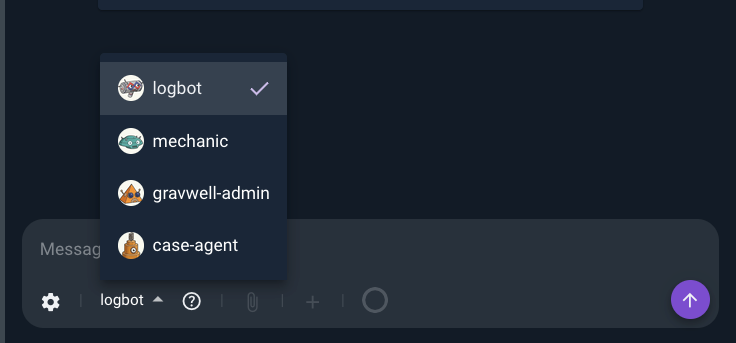
Agent selection: Logbot gives analysts access to specialized AI agents for investigations, administration, and troubleshooting.
Read the above list of what Gravwell agents can do again with the four senior-level analyst attributes in mind.
- Know where the data is: list tags, sample entries.
- Know what normal looks like: run the statistics.
- Know the query language: parse, validate, execute.
- Know the plumbing: alerts, flows, playbooks. Everything a senior would click through, an agent can call.
This is institutional knowledge of the environment that is now instantly accessible to all team members, junior and senior alike. With this expanded reach, here are a few examples of tasks junior analysts can tackle in their first month that previously required years of experience or assistance from senior colleagues.
1. The investigation that doesn't wait for the senior analyst
An alert fires on an unusual outbound connection from a finance workstation. The junior analyst opens the Case Agent and asks what it knows about that host.
The agent lists the tags that contain data associated with the host, samples recent entries, and pulls the authentication logs to figure out who was logged in. It correlates against DNS and the proxy tag and comes back with a timeline. So far, simple. Except the destination resolves to a payroll vendor, which means the connection is probably legitimate. Only, the vendor's IP changed last week, which is why the detection fired, because the allowlist resource the detection references still has the old address. And, the allowlist was last touched fourteen months ago by an engineer who no longer works here.
The junior analyst did not know any of that, but fortunately, the agent can quickly tell them because it looked at the resource metadata. Looking at things like this is the part that used to likely require seniority.
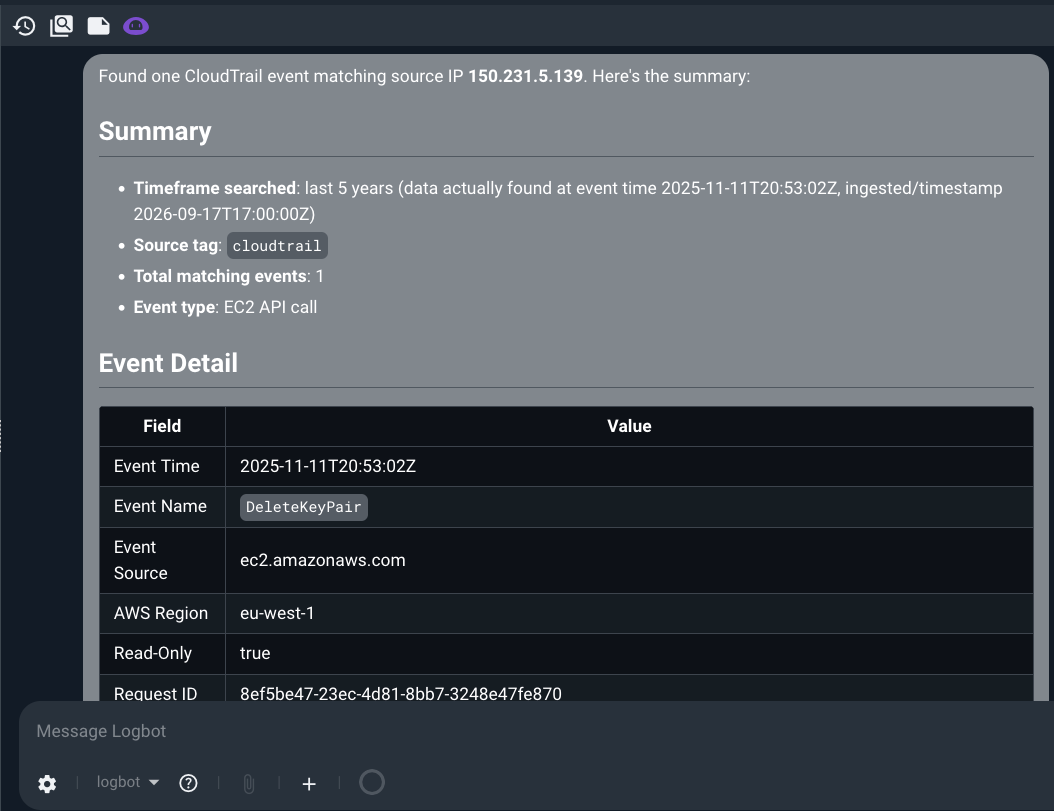
CloudTrail investigation: Logbot identifies and summarizes relevant CloudTrail activity, helping analysts quickly understand security events.
The Case Agent can surface the underlying queries and evidence supporting its findings. Rather than accepting a summary at face value, analysts can inspect the results, rerun searches, and independently validate the conclusions.
tag=zeek-conn json id.orig_h=="10.20.4.117" id.resp_h id.resp_p service
| stats count by id.resp_h id.resp_p service
| sort by count desc
| table id.resp_h id.resp_p service count
The junior analyst can run the query above, change it, and argue with it. They are reviewing evidence, not trusting a summary, which is the difference between a knowledgeable assistant like Logbot and AI that draws its own conclusions. You want the former.
2. The query language stops being a gate
The most common thing standing between a junior analyst and a good investigation is not a lack of ideas. It is the twenty minutes between "I wonder if that service account authenticated from anywhere weird" and a query that actually answers the question.
Logbot writes and validates Gravwell queries from plain language. The junior analyst types "show me every host and source IP that authenticated as svc_payroll in the last day," and the Case Agent parses a query, checks that it is valid against the instance before executing it, and returns the results and a plain-English explanation of what each module is doing, such as the one below:
tag=winlog winlog TargetUserName=="svc_payroll" EventID==4624 Computer IpAddress
| stats count by Computer IpAddress
| table Computer IpAddress count
The junior analyst can also attach a handful of raw entries from a search and ask the agent to explain or summarize them, which is how you learn a new log source without a senior analyst standing over your shoulder.

Natural-language querying: Logbot translates plain-language questions into Gravwell queries, explaining the logic so analysts can learn as they investigate.
Logbot not only surfaces the correct query, it also explains why that query is best and offers to help optimize the investigation if the analyst wants to search for something more specific.
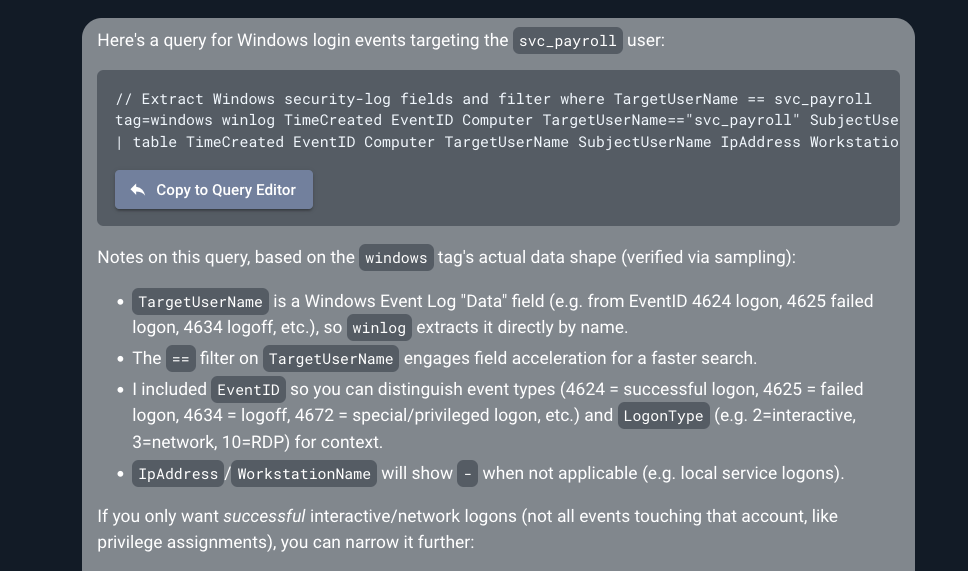
Syntax Fluency: Logbot builds the best possible query for the hunch an analyst is trying to pursue, with notes about why that query is best.
The hunch-to-query gap closes, which means syntax fluency becomes less important than the quality of the hunch.
3. The environment memory that never leaves
Search history and playbooks are things the agents read. This may seem trivial, but it is not. It means the institutional knowledge finally has somewhere to live that is not a single person.
When a senior analyst documents why the Okta integration uses a nonstandard tag for detecting malicious logins, that knowledge becomes available to every junior analyst through the agents. When the Admin agent is asked "why did the Windows tag drop 40% overnight," the Case Agent checks ingester connection stats, well statistics, and indexer health and comes back with a probable cause. A junior can ask that question at 3 a.m. and get an answer. Today, in most SOCs, that question is a Slack message to the one engineer who remembers the last time it happened, and it has to wait until they wake up.
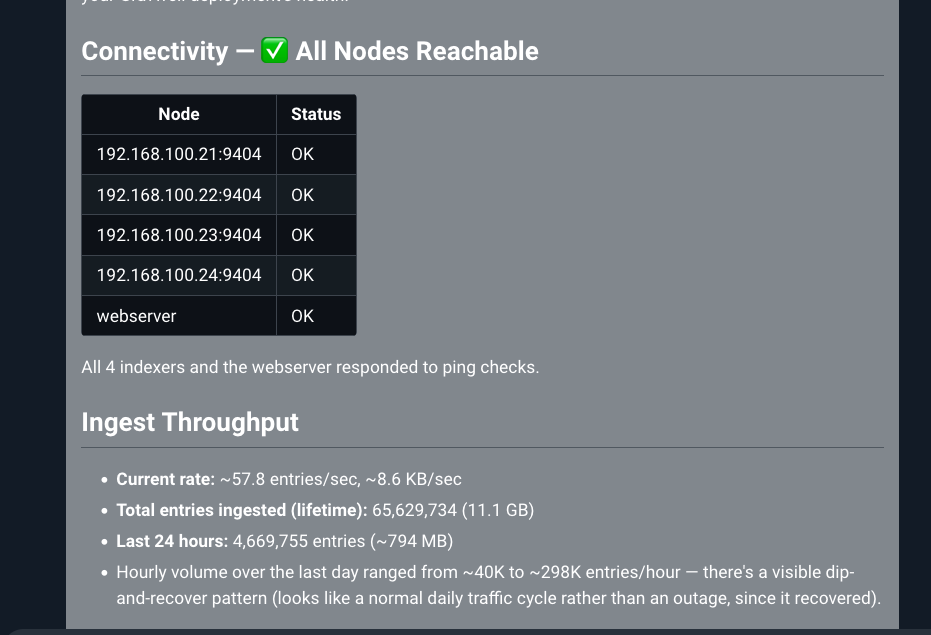
Environment health: Logbot surfaces deployment health, connectivity, and ingestion statistics without requiring deep platform expertise.
4. The unattended work that used to be senior busywork
The agents above are conversational. The preview kit also ships agents that run unattended from flows: alert triage, deployment audit, and a daily activity summary. These are the ones that change the headcount math directly, because first-pass triage and the morning "what happened overnight" briefing stop being analyst-hours at all. The deployment audit is the same function I described in the dead detections post: it walks the library, tests each detection against live data, and hands a human a ranked list of the ones that cannot fire. That used to be a senior's quarter. Now it is a scheduled job.
What This Does to Your Team’s Output
For SOC leaders, the potential impact extends beyond individual analyst productivity. Making institutional knowledge accessible through AI can shorten the path to meaningful contributions from new hires, reduce interruptions for senior personnel, and allow existing teams to investigate more activity without proportionally increasing headcount. Just as importantly, critical environmental knowledge becomes less dependent on the availability of a handful of experienced employees.
Query-language fluency, environment memory, and knowledge of the plumbing become democratized because the Gravwell platform carries those now. Successful analysts are now defined by judgment about what matters, curiosity, the discipline to verify what the agent tells you before acting on it, and the ability to write clearly for the people who have to act on the findings, which are attributes not necessarily tied to years of experience in a particular environment.
As a result, the team takes on a new shape. Senior analysts can spend less time answering routine questions and more time on architecture, detection engineering, and building the knowledge bases that agents use. Junior analysts can now conduct meaningful investigations in their first month, with the platform extending their reach. The senior's job shifts from answering "where is the data" for the fortieth time to reviewing the agent's proposed changes and deciding which of them ship.
However, it’s important to be honest with yourself about the limit. The agent has reach, not judgment. It does not know that the suspicious login at 4 a.m. is your CEO on a flight to Singapore. It does not know that the vendor IP change was announced in an email your finance team forwarded to nobody. That is the human's job, and it is the job you should be hiring for.
And do not read this as permission to run the SOC on three interns. Reach without a reviewer is how you end up confidently wrong at scale, and confidently wrong at scale is worse than slow.
The Guardrails You Were Going to Ask About
Nothing changes without human approval during interactive sessions. Read-only tools run without interruption. Any tool that would modify the environment, such as saving a query, creating a macro, or updating an alert, pauses the conversation and requests approval.
You can approve one call or accept that tool for the rest of the session. Agents that run from flows are automations and cannot ask, so every tool they call executes without prompting. Only grant write tools to an agent if you intend for it to make unattended changes, and treat that decision like you would treat granting a service account write access to production, because that is exactly what it is.
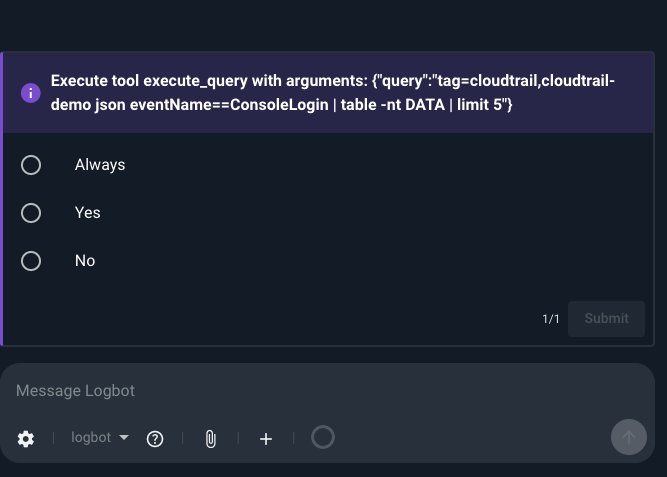
Human approval: Logbot keeps analysts in control with explicit approval options for agent tool execution.
Access is bounded by CBAC. An agent can only use tools the user driving it is permitted to use, and an agent definition can narrow that further. AI access can be disabled per user, per group, or for the whole instance in gravwell.conf.
Your data stays where you put it. Gravwell-hosted AI runs on Gravwell's own GPUs in Gravwell's on-prem, SOC 2-compliant infrastructure. There are no third parties involved, and it is not trained on customer interactions or data. If your policy requires it, you can point Gravwell at any OpenAI-compatible endpoint instead, including a model you host yourself, and the AI traffic never leaves your control.
It is not a walled garden. The same tools are exposed through an MCP server gated by CBAC and token permissions, so the AI tooling your team is already standardizing on can drive Gravwell too.
Why Analyst Reach Is a Natural Job for AI Agents
The work a senior analyst does for a junior is bounded (i.e., this environment, these tags), repeatable (the same "where does that data live" question a hundred times a week), and verifiable (every answer has a search behind it that anyone can rerun). Those are exactly the properties that make delegation to an agent safer and more accountable. The industry is fixated on AI as an alert summarizer, and summarizing an alert is the least interesting thing an agent with real tool access can do. The interesting thing is handing a first-year analyst the keys to the whole environment and having them come back with a timeline and the evidence to defend it.
Logbot already provides the conversational foundation. The promise of security agents isn't simply that they can do more work autonomously. It's that they can do that work with the evidence, tools, permissions, and operating context necessary to make their output useful and accountable. Gravwell 5.10 brings that model into the platform.
Give your analysts greater reach without sacrificing oversight. See how Gravwell Logbot makes institutional security knowledge accessible across your SOC. Schedule a personalized demo.